Sunday, 21 July 2019

Night-owling - something to grouse about!

Been a while since anything got posted so I thought last night's exploits may warrant a resurgence of the blog.

This time of the year I am usually pretty much nocturnal doing various Nightjar surveys in  Mid, North and South Wales. This year is no exception and along with Ed O'Connor I was out at Clocaenog last night trapping and tracking Nightjars to assess the potential impacts of recent wind-farm development. At one nest, found right in the middle of a horribly dense Sitka Spruce plantation by radio-tracking the female, we managed to catch the male and he turned out to be one of the six birds we had fitted GPS trackers to last autumn to discover more about the migration routes of British Nightjars. Annoyingly, two of the trackers we  recovered earlier in the year proved to have failed to record any locations - truly gutting given the time, effort and expense lavished on them. Fingers crossed it is 3rd time lucky with this one.


Whilst thrashing through the near impenetrable spruce trees last week searching for this nest I inadvertently flushed a roosting Long-eared Owl. Well last night, armed with a tape-lure forwarded to me by Ewan Weston, I thought we might fill the quiet mid-night period in Nightjar activity not by sleeping, which would have been the sensible thing to do, but by trying to tape-lure the owl. On walking up to the area I had flushed it from we suddenly heard the unmistakable call of a recently-fledged Long-eared Owlet out in some open ground just adjacent to the plantation and soon managed to catch it with a torch and a landing-net.


Making itself look as big and frightening as possible is a good defence for this young Long-eared Owl. Was pretty feisty to handle too!

As if all this wasn't exciting enough out from the heather burst a couple of large game birds and quite instinctively I managed to catch one by hand as it flew past. The bird, which turned out to be a half-grown grouse chick caused us some serious soul-searching, mainly because at that time of night, with no internet access and little previous experience neither of us was sure exactly what it was!! I had originally assumed Red Grouse but then realised that Black Grouse was not out of the question either!! If it was a Red Grouse chick it was large enough to take the recommended F size ring - if it was a Black Grouse chick it wasn't big enough to take the larger G size ring recommended for that species. Two of the primary rules of the ringing scheme are that:-

You should only ring a bird if you know what species it is.

The safety of the bird comes first. 


A 'grouse' chick

Fitting the wrong size ring to a half-grown chick would be a serious welfare issue so it was released unringed. 

I have sent some photos to a Grouse expert for confirmation but think we are coming down on the side of Black Grouse at the moment!

Saturday, 11 May 2019

Live-streamed Curlew Nest


Today, Tim Lewis and I, installed this year's Curlew Country 'Curlew Cam' on a nest in the Corndon Hill area of Shropshire. The bird has been sitting for about a fortnight - protected by an electric fence (which you may hear clicking) since it was found on 28th April. Hopefully, the nest should hatch at the end of May.

Click the link below to take you to the live-feed

https://curlewcountry.org/curlew-cam-2019/ 

Thursday, 10 January 2019

A tale of two finches

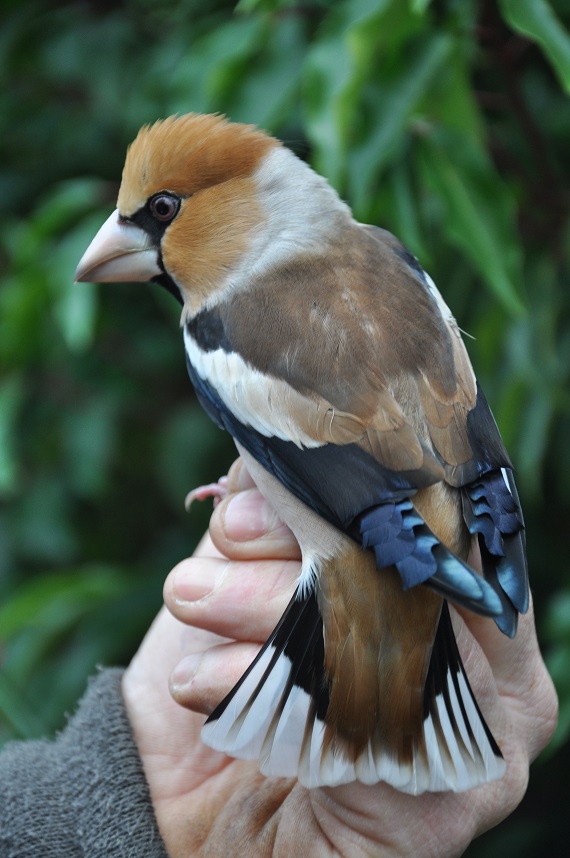
2018 has been an interesting year for finch ringing here in Mid Wales in very different ways. Our Hawfinch RAS project got off to a brilliant start both in terms of new captures and re-sightings of colour-ringed birds with 125 new birds ringed (bringing the grand total to over 1,000 individuals in just 8 years) and there were also 1,342 recaptures or resightings.


Adult male Hawfinch, a feisty fella in fine fettle (© Trevor Bashford)

In late April however the wheels came off when we started to notice an increasing number of birds showing signs of trichomoniasis, a condition cause by the protozoan Trichomonas gallinae. This disease has been well-known to affect Greenfinches but has previously been little reported in Hawfinches, although we have seen the odd sick bird in previous years. In April 2018 Trevor and Chris Bashford, owners of Britain's best Hawfinch garden (over 240 different identifiable individuals in 2018 alone!!), were reporting regular sightings of sick birds despite diligently cleaning and disinfecting their feeders. Numbers were so worryingly high that I asked everyone to stop feeding immediately at all our feed sites and effectively brought our year's ringing activities to an abrupt end. A local press-release by BTO Cymru's Kelvin Jones requesting other local bird-watchers to do the same was well-heeded and many brought their feeders in for a while. Sick birds were continuing to be reported well into June however. It was heart-breaking to see familiar faces (well, familiar legs!) fluffed-up and struggling to swallow. Whilst their is a treatment that can be used, once the condition becomes noticeable in an individual it is too late, the infected bird rarely lasts more than a few days. Early diagnosis would involve opening the birds beak and looking down its throat but that is pretty much impossible, and potentially very painful!!  Some of these birds have been regular attendees over several years with many tens of re-sightings each and then nothing!

Entering all the data for the year from Trevor and Chris's log-book just recently has brought the scale of the problem back into focus and it was devastating to note the inevitable disappearance of old regulars following a few days of them being noted as "sickly".  The potential scale of this problem is demonstrated in the staggering fact that during the whole year, targeting finches in several locations the Group never caught a single Greenfinch!! For the first year ever I cannot remember seeing one in my garden either.

In late June, as is usual, the surviving Hawfinch dispersed into the countryside to take advantage of the rapidly ripening natural bounty of seeds and berries and feeding at garden feeders became a rare event until late December. Hopefully the decreased potential for disease transmission in these feeding conditions and the exceptionally dry summer has reduced the protozoan numbers. This year's Hawfinch RAS project is up and running and, fingers crossed, there have been few signs of a repeat of last year's tragedy and it is heartening to see some very familiar old stagers have made it through. Clearly some birds must be immune, or at least more immune, than others but, none-the-less, if we have a repeat incident this year we will not hesitate to bring proceedings to a halt again. I am not sure how effective our stopping feeding can be with so many others now feeding too but the health and safety of the birds must always come first.

On a much brighter note, this winter's Brambling catching has been record-breaking with Paul and I ringing nearly 1,500 Bramblings between us so far at 3 main catching locations. It is a bit early to expect any recoveries but we have controlled 6 foreign-ringed birds (2 from Sweden, 2 from Norway, 1 from Belgium and 1 from the Netherlands and have had 5 British controls too. An additional Norwegian-ringed bird was id'ed by Kev Joynes, a local bird-photographer. I will post a map showing all the locations of origin as soon as we get them all back.


A rare 'pea-throat' male Brambling, one of only two such individuals caught

Saturday, 8 December 2018

Too wet to whoosh!


Stunning adult male Brambling

Over the past few weeks we have been having great success targeting a large invasion of Bramblings. These attractive finches are irregular visitors in large numbers to the area's many beech woods when beech-mast crops are high. Two sites we operated on the last big invasion in 2013/14 (catching just over 400 birds) once again saw good numbers present as has a new site. These three sites combined have so far yielded over 1,000 new birds ringed and 4 controls - 2 from Norway, 1 from Belgium and 1 same season movement within Wales.


Norwegian-ringed female Brambling


Most birds have been whoosh-netted but unfortunately dry conditions are essential for whoosh netting and we haven't been getting a lot of those recently. This morning I sat and watched for over half an hour whilst literally hundreds of Bramblings helped themselves to the free hand-outs on the whoosh-net site. A new bird-food order was placed this afternoon!


The weather in a couple of days time is looking dry so watch this space!

Tuesday, 30 October 2018

Noughts and crosses...

Despite being a relatively common species in the UK, we rarely get to catch Common Crossbills. We have a couple of sites where we try most years to trap them, but given that their number fluctuate greatly and that we have to rely on a number of other factors to be able to catch them: no wind, not too much surface water, their drinking ponds to have water in them and most importantly the birds have to be present.
Today was one of those days where everything fell together. As we were setting up the first net, I could hear Crossbills nearby. As we arrived at the second net site I could see some already coming down to drink (I was actually a bit annoyed that we hadn't set that net up first). Unfortunately they flew away as we started to set up the net. I was hopeful that they would return. To my amazement, just after we finished setting up the second net we walked past the first net (just 5 minutes after setting it up) only to find 9 birds in there already - all of them were Crossbills!! I was hoping we might catch one - as I always am when we come here, but to catch 9 was just incredible.
To show just how good this catch was, we have been coming to this site several times a year for the past 8 or 9 years, and in that time have only ever trapped 19 Crossbills in total (4 in 2010 and 15 in 2011)! Hopefully it won't be another 7 years until we catch some again. It definitely makes up for all those occasions when we didn't catch any.


Other birds trapped during the 1 hour that we were there were: 5 Siskin, 3 Goldcrest, 2 Coal Tit and 1 Dunnock.

Sunday, 28 October 2018

Hello, EZ39944, how was you journey?

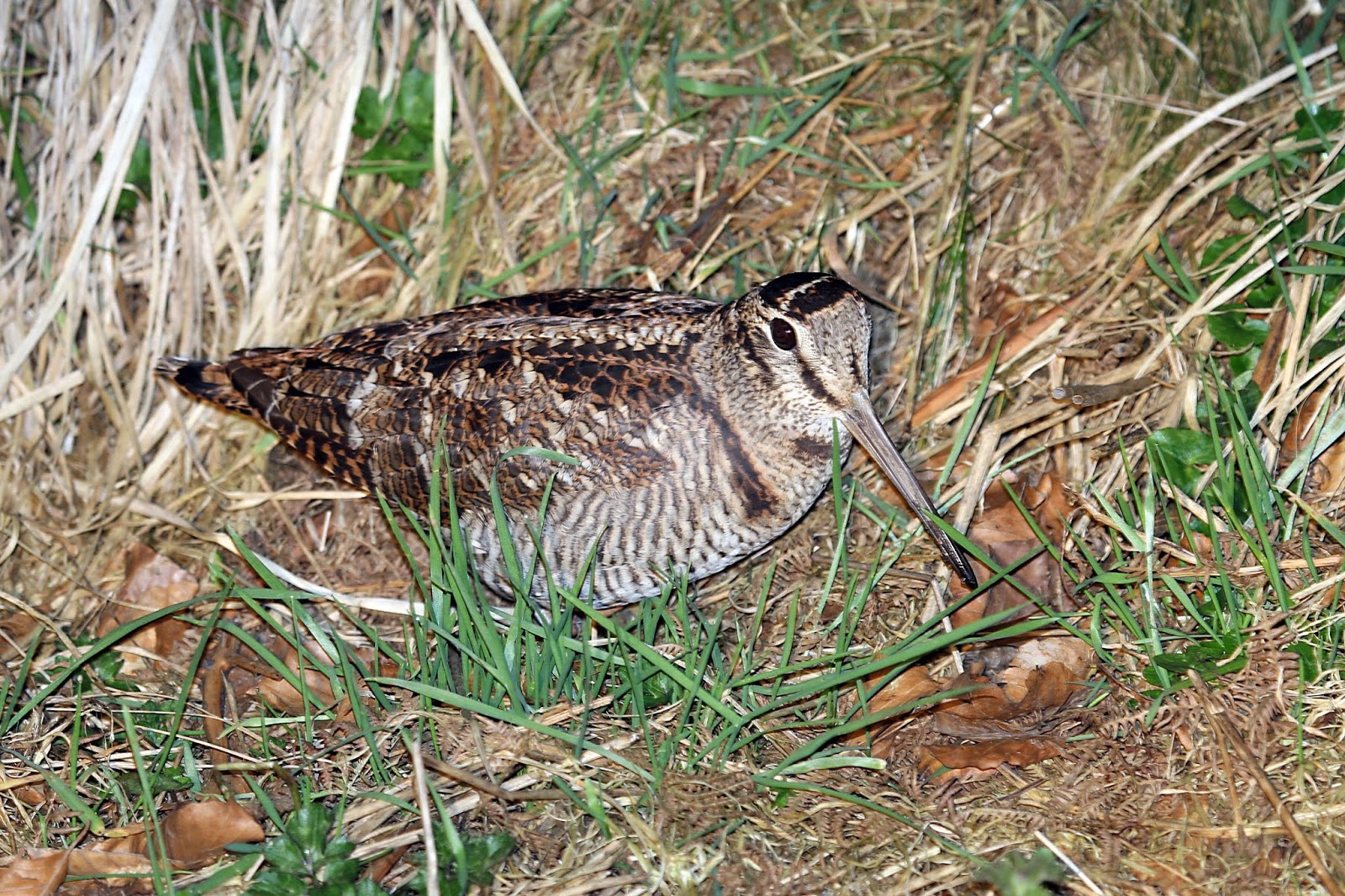
My first woodcock of winter 2018/19, a re-trap of a juv I ringed on exactly the same spot on Jan 18th 2018. It was even more special as it was on home ground 10 minutes walk from my back door.


Tuesday, 10 July 2018

Welsh Osprey ringing 2018


Dyfi Osprey chick 'Dinas' at ringing - © Emyr Evans, Dyfi Osprey Project

Apologies for lack of postings recently, the fine weather has meant there has been very little downtime so far this year!!

Below is a link to 3 videos of the ringing of three of the five known Welsh Osprey nests this year. One additional nest is known to have failed and the remains one will hopefully be ringed by other ringers soon, giving, as far as we are aware, complete coverage of all Osprey chicks reared in Wales in 2018.

And, just for fun, there is a link to the Dyfi Osprey Project chick naming ceremony!

Glaslyn Osprey ringing 2018 (done on behalf of Kelvin Jones)


Many thanks go to Emyr, Janine and Kim at Dyfi Osprey Project, Nick Kite at Dwr Cymru, Heather Corfield et al at Glaslyn Wildlife, Kelvin Jones, Adrienne Stratford. Ilse and Tamsin for permissions, videos, help and assistance.

Wednesday, 23 May 2018

Curlew Cam 2018


Curlew nest monitoring and protection is in full swing at the moment with several nests fenced and 50 eggs safely installed in incubators - fingers crossed for a good hatch.

Here is a link to our current Curlew Cam nest in a silage field in South Shropshire, enjoy it while you can!

curlew-cam-2018

Monday, 21 May 2018

From Russia with mixed emotions!!


The Woodcock that winter in Wales are mostly winter visitors from the continent and we have had many recoveries from our targeted ringing of this species over the past few years to show where exactly they come from. This May though has seen an exceptional rash of Russian recoveries, eight in total, including what is probably the furthest reported movement ever for a BTO-ringed Woodcock at 6,267kms. This massive movement was made by a bird ringed on the University Farm at Trawscoed near Aberystwyth on 4th January 2017 and recovered on 13th May 2018 50km north of Krasnoyarsk, Russian Federation. As can be seen from the map below that is north of Mongolia and about halfway through China!!

These recoveries are received with mixed emotions, on one hand they yield important data on Woodcock movements and hunting pressures but on the other they are all shot birds so will not be making any return journeys! Should you be a shooter reading this, next time you raise your barrel at a flushed Woodcock just take a couple of seconds to wonder (in both senses of the word) how far it has flown to be in your sights, hopefully a couple of seconds should be just long enough!!


The final Russian resting spots of eight Welsh-ringed Woodcock


All foreign recoveries of BTO ringed Woodcock up to the end of 2016

Robinson, R.A., Leech, D.I. & Clark, J.A.(2017) The Online Demography Report: Bird ringing and nest recording in Britain & Ireland in 2016. BTO, Thetford (http://www.bto.org/ringing-report, created on 5-September-2017)

Wednesday, 21 March 2018

Waxwing-less

This time last year we were caught-up in a veritable Waxwing fest. A flock of up to 100 birds graced the local town of Newbridge-on-Wye for nearly 4 months. During their stay they were tempted down to strategically placed apples and all bar a few were caught and fitted with unique colour-ring combinations courtesy of Raymond Duncan of Grampian Ringing Group. During the process several colour-ringed birds were identified that had been ringed elsewhere including four from Scotland and one from Norway. Unfortunately, because the local apple supply was so good, few of the birds left us to wander further south where they might have been snapped by eager photographers as happened a few years back when they last invaded Mid Wales. Most stayed local until mid April and then presumably just headed straight back without being re-sighted or photographed on the way.

This winter sadly has been Waxwing-less - in Wales anyway. Despite this there has been some Waxwing action though as I have been batting poor quality photographs backwards and forwards with birdwatchers in Northern Norway and Northern Sweden in an attempt to identify colour-ringed individuals intent on hiding their identity. It seems not even the Beast from the East could tempt these birds to leave their usual Northern haunts this winter as we received not one but two reports of ex Mid Wales birds over 2,000km north of where they had spent last March in temperatures as low as -22 degrees C! Colour-ring sightings from this far north are almost unheard of, especially in mid-winter!

First to be reported was an adult female ringed by me at Newtown College on 4th February 2017 that was photographed on 30th January 2018 in Hammerfest, Finnmark, Norway by Bodil Brox some 2,431 kms NE


Adult female originally ringed at Newtown College and then re-sighted in Northern Norway

Then, amazingly, another adult female originally ringed in Ballater on 18th December 2016 by Grampian Ringing Group (but next photographed by me in Newbridge on 8th January 2017 - 539kms S) was reported on 25th February 2018 at Pitea, northern Sweden (2,025 km NE) by Sture Sandberg.


Adult female, ringed in Scotland, re-sighted in Wales
 and then re-sighted again in Northern Sweden


These sighting, so far north and in mid-winter, are exceptional and well worth all the effort spent catching and colour-marking these beauties last winter.