Tuesday, 13 December 2016

Whimbrel records building slowly


Today I received an email from José Velhote informing me of a sighting of one of our colour-ringed Whimbrels at Murtosa, Ria-de-Aveiro, Portugal (see photo above). This is the first sighting of a West Wales colour-ringed ringed Whimbrel in Portugal and follows on rapidly from a record of a colour-ringed bird from Pembrokeshire recently photographed in the Gambia (surprisingly the first record of a BTO-ringed Whimbrel in Gambia)

The bird in question was ringed at Llanon on 3rd May 2010 and was resighted on 1st May 2016.


Friday, 9 December 2016

North or South, that is the question!

Have recently received this photo from Andy Davis of a colour-ringed Kestrel at Little Neston on the Dee Estuary taken on 28th November 2016. Apparently it has been mobbing Short-eared Owls and stealing their catches.


Thanks to Andy for the record and allowing us to use the photo.
  Visit Andy Davis Flickr page for more stunning images

I assumed this was probably one of the few birds we colour-ringed in North Wales but having just looked it up was surprised to see it was a bird we ringed as a chick on 26th June 2016 in one of Chris Griffith's nest boxes high in the hills above Caersws, 85 kms from where it is now. The behaviour should have been a clue to its origins! It is one of the great fascinations of bird-ringing as to why one Kestrel from North Wales goes to Northern Spain for the winter whilst another moves north to winter on the Wirral! If it is still there at Christmas I'll have to nip over before dinner and say hi!


Friday, 25 November 2016

H'owls that!

Prince Edward Point Lighthouse at dawn,
 a scene which greeted me every morning 
With University finished and needing to spread my wings, I decided to volunteer for the autumn (fall) at Prince Edward Point Bird Observatory (PEPtBO) from late September until the end of October. Prince Edward County is located on the north eastern shore of Lake Ontario, about 2hrs east of Toronto - a whole oceans width away from Mid Wales.

Northern Saw-whet Owl, one of 715 caught
 in October
Although a relatively small bird observatory, due to its location right on the tip of a peninsular, it processes a huge number of birds in the fall. The operation is smoothly run by master bander Dave Okines and two fall banding assistants (one of which was me), and a brilliant group of volunteers. The first thing I learnt was some lingo: rings are bands and ringing is banding...luckily with Dave being an expat from Britain, skull ossification was kept to a minimum, with moult and feather wear being used to age birds instead.

The real draw to the station was to witness the fall migration of Northern Saw-whet owls, a small species which breeds in the boreal forest in the north of Canada and migrates as far south as North Carolina in the US. The owl banding was broken down into two separate periods: the standard 4 hour period carried out by myself and the other assistant, then a non-standard period which was carried out until morning by David if the weather and the wind direction was favourable. 10 owl nets were opened each evening around an audio lure which attracted the owls into the area.

Barred Owl, innocent looking but will quite
happily feed on Saw-whets if given the chance.
It certainly didn't disappoint. In total 715 Saw-whets were banded during October (an astonishing number), with 167 caught in one night alone, 93 of which were during the standard 4 hour period. Each bird was banded and biometrics and a moult card taken for both wings on birds exhibiting any moult before they were released to continue on their migration. Moult was often obvious, although it could be checked using a UV light with new feathers showing up pink from the presence of the chemical porphyrin. This eventually wears off over time, allowing a pattern to be seen between new and old..

Not quite a nightjar, an Eastern Whip-Poor-Will

It wasn't just Saw-whet Owls which were caught: 22 Barred Owls, 5 Long-Eared Owls and a single Eastern Screech Owl were caught during my stay. The owl nets also caught a couple 
American Woodcock, half the size of the 
European Woodcock I'm used to ringing
of species I was really hoping to see, but wasn't sure I actually would. An Eastern Whip-poor-Will was caught
whilst showing a visiting owl bander from the US the setup one afternoon. It helped demonstrate how quickly the nets could be opened and closed. The second  species was an American Woodcock which graced the nets early one morning - a very unusual fall record.

Two tiny male Kinglet species, Golden Crowned Kinglet
 & Ruby Crowned Kinglet.
Migration monitoring also took place in the cedar woods each morning. This used a mixture of 38mm mist nets and larger 100mm hawk nets, along with a Jay Trap and 6 ground traps. These methods caught a wide variety of species during my stay, which ranged from the tiny Golden-crowned Kinglet to the somewhat larger Red-tailed Hawk!

Sparrow lineup: Lincoln's Sparrow, Slate coloured Junco,
Swamp Sparrow, juv White-Crowned Sparrow
With my very limited knowledge of North American birds it was a steep learning curve, but I soon got used to it and it wasn't long before I could identify and age the wide variety of fall warblers, flycatchers and sparrows which regularly appeared in the nets (they even seem to cause a lot of confusion to American birders). Other more obvious species were also caught such as the Blue Jay, a common and charismatic species that is caught in large numbers throughout the fall with 166 being caught in a single morning during peak migration.

Blue Beauty, adult male Sharp-Shinned Hawk
A surprising number of raptors were also caught during my stay, 6 species were caught during the fall. Sharp-Shinned Hawks were the commonest hawk caught, with both females and males banded allowing a range of ages and moult patterns to be seen. 5 Cooper's Hawk were also caught, with all the birds being young birds, a single Merlin, 2 Red-Shouldered Hawks and 4 Red-Tailed Hawks were also caught.


The standout highlight though had to be the juvenile female Northern Goshawk which was caught, a very smart if a little noisy bird to band. It was a brilliant experience, I learnt a lot, saw new ways of setting up nets and heard about some of the more unusual methods of lamping shorebirds and ducks (they use an airboat!). In total I banded and processed 73 species, with a surprising degree of similarity to the species I trained on in Britain. How amazing would it be if one of them ends up in the nets here in Mid-Wales...?

The Northern Goshawk and hairy bander, this is the only real way to show the size of the bird,
an amazingly long tail and this was only a SMALL female...

Monday, 7 November 2016

Colour-ringed Curlew Control


Just had the details of a colour-ringed Curlew I read in a field above Lledrod on 14th June 2016. Amazingly, given the time of year, it was a French-ringed bird!

Friday, 28 October 2016

Winter in Spain


Ever wondered where all the Kestrels are when you are trying to find one for your New Year's Day Bird list? Surprisingly a good number of our British breeding birds move south for winter. We have just been notified of a bird that I ringed as a chick in June 2015 in North Anglesey, that was recaught by ringers at Vitoria-Gasteiz, Aberasturi, Spain on 16th October 2016. Whilst there have been 181 British-ringed Kestrels found in France this is only the 21st to be recovered in Spain. There have even been 4 recovered in Morocco. If a sizeable proportion of our breeding birds are moving south into France and Spain for the winter then the wide scale use of rodenticide poison to control vole plagues in these countries could be one of the reasons we are seeing a decline in our breeding population.

Happily this bird was released alive and well - we will be keeping a keen eye open for it to see if it returns next spring.

Sunday, 23 October 2016

Jackpot...

For the last few months I've been working away in Yorkshire, which on one hand has been great for bird watching but also very frustrating that I am so far away from any of our ringing sites. So when there has been any opportunity to go back to Wales, I've gone. Last night was one of those opportunities, so when I had finished work I headed home stopping at some of our winter wader ringing sites en route. With the moon not up until 23:45 I knew I had plenty of time to search the fields. The main species I was searching for was Jack Snipe (so Silvia and myself can continue our study on them), although as usual I'm happy to see/catch most species. I was not disappointed, after searching four of our sites I must have seen at least 30 Jack Snipe quite evenly distributed between the sites. Many of the birds we mixed in with Snipe 'flocks' making them hard to get near, but I did manage to find 10 or so on their own of which I caught 6! All 6 birds were new, which I was a bit surprised by, given that over the past 3 winters we've probably ringed 150+ individuals between the 4 sites. Maybe it's a sign that it's going to be a bumper year for them, fingers crossed.


Several other birds were seen throughout the searching including 50 Golden Plover (3 were trapped), 10 Lapwing, 250 Snipe (2 were trapped), 2 Woodcock (1 was trapped), 6 Fieldfare (2 were trapped) and 2 Skylarks.

Friday, 7 October 2016

Interesting Dunlins?!

Anyone who has been on a big dazzling catch at Ynyslas with me will know that I can be just a bit disparaging about Dunlin (or Sea Dunnocks as I've been known to call them). The BTO have just emailed me a couple of recoveries that put me right on this matter and confirm that, far from being boring, these common and unassuming little waders do put themselves about a bit!

The Dunlin that we caught on 22nd July 2016 with a San Sebastian ring had been ringed on 13th August 2015 at Parque National Marismas del Odiel, Huelva, Spain (1,707 kms due S). Interestingly we have just had a colour-ringed Sandwich Tern recorded from the same place  that was originally ringed at Ynyslas.

Also, a Dunlin ringed at Ynyslas on 24th September 2014 was retrapped by Swedish ringers at Ottenby on 23rd July 2016, 1,387 kms ENE

The two recoveries are shown on the map below with some of our other recent Dunlin recoveries and controls. The green markers show the origin of foreign-ringed birds controlled at Ynyslas whereas the red markers show the recovery site of birds ringed at Ynyslas.


The map is starting to show the great importance of the Dyfi as a migratory stop-off point for birds moving between their northern breeding sites and southerly winter quarters. Our new colour-ringing project will hopefully increase the number of movements we can chart and make far more of the Dunlin we ring 'interesting'.

Saturday, 1 October 2016

Nocturnal wader catchers

Last night was the first in the next good set of tides for ringing waders at Ynyslas so I headed down just before high tide. There were a good number of birds present, including at least two Dunlin colour-ringed on the last high tides over a week ago indicating that some birds will hang around a while to fatten-up before presumably moving on. Another colour-ringed bird has already been recorded further south in Cornwall and a Dunlin ringed earlier in the autumn before we started colour-ringing has just been controlled in North Wales.

Last night I managed to colour-ring another 59 Dunlin and had what is probably a record catch for the site of 17 Knot, including a juvenile bird ringed elsewhere. There was added interest in the shape of a Bar-tailed Godwit and a Grey Plover, neither of which are ringed in any number by the group.

I wasn't the only one out catching waders there last night though. Towards the end of the tide a shadowy figure floated low over my head and landed on the sand just in front of me. Two stealthy approaches later (it flew off on the first and landed again a bit further away) and I had yet another Short-eared Owl for the site safely under the net.


The bird was an adult female in wing moult, so almost certainly a local(ish) breeding bird rather than a migrant, but clearly from her weight she was at least as successful at catching waders as me!


Tuesday, 13 September 2016

A little bit of magic!

On Sunday, Jaques was keen to have one last ringing session before he heads off to Prince Edward Island, Canada on a 2 month ringing trip. We started with a little bit of dazzling just south of Aberystwyth where we managed to catch a Bar-tailed Godwit, an Oystercatcher and a single Dunlin which, apart from a few Ringed Plovers, was pretty much all we saw.

This time of the year is a good time to tape-lure Meadow Pipits as they commence their autumn migrations. The weather was perfect too with light winds and a little bit of hill fog so at first light we headed into the hills and set up a couple of mist-nets in a 'V' shape and placed the sound lure in the centre. Almost instantly pipits began responding and during the course of the morning a modest but steady 44 were ringed. Most were 1st year birds aged on the moult limit in the greater coverts although there were a couple of adults included, both showing the last traces of moult on their inner secondaries.


1st year Meadow Pipit showing pale and 'toothed' median coverts

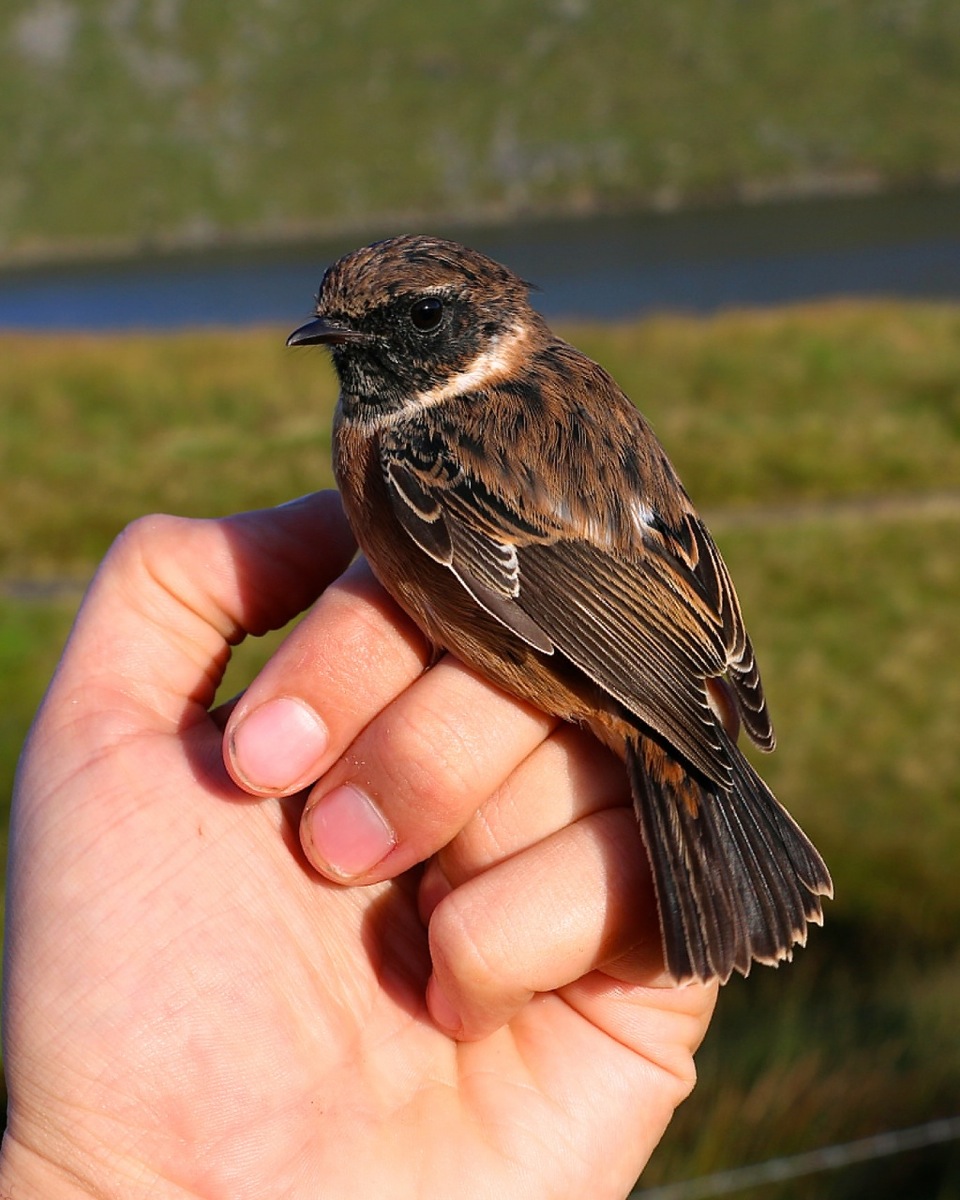
The activity of the pipits attracted the curiosity of a couple of Stonechats, one of which was also caught and ringed.


 1st year male Stonechat

After browsing the Ringers' Facebook page for a while on Jacques phone, and trying to decide if social media is really all that 'sociable', I glance up. "What's that in the net?" I ask whilst simultaneously bundling myself out the door as fast as I can manage.


This stunning adult male Merlin was obviously hunting pipits too (but luckily no pipits were hurt during the taking of this bird)! A classic example of how ringing is full of lovely little surprises!


Friday, 9 September 2016

A very unusual ringing site!!

On Wednesday evening Jacques and I were heading down to Borth to try for a few more Swallows and then kick start the Group's new Dunlin colour-ringing scheme at Ynyslas later on. Anticipating a long night we thought we better fuel-up beforehand so stopped off at the Acorn Fish and Chip shop in Borth where the great excitement amid the queuing customers was the presence of a small bird fluttering in the dark recesses of the wooden A frames high above the deep-fat fryer, periodically sprinkling the chips with dust and droppings. "We'll sort that for you" I said "we're bird catchers!" A blank expression confirmed that the Oriental women behind the counter had absolutely no idea what I was on about. "No, really we are" adds Jacques - but still no recognition! "Want us to catch it for you?" I try again. "I would" says one of the other waiting diners, so, quick as a flash I run to the car and come back in with an extending hand-net. One deft swipe at full stretch and the bird (which bizarrely for a sea-side town with no trees whatsoever turns out to be a Treecreeper) is safely under the net on the floor of the chippy to rousing applause from the open-mouthed onlookers (well almost)! It was perhaps one of the most pressured and therefore one of most satisfying catches ever, a bit like a scene from Ghostbusters (the old version, obviously!). "Thank you very much" says the Oriental women smiling broadly, "no problem" I say, "Worth free chips that?" I try but unfortunately the blank expression had already returned! Still it prevented said Treecreeper from becoming just another Scottish delicacy!

I wonder if this is the first bird ever caught and ringed in a serving chip shop?!


A record shot of one lucky Treecreeper just prior to being liberated on Borth Bog

In something of an anticlimax the Swallow roost behind Borth produced just 20 new birds, although it is getting on and they will possibly be the last 20 of the year.

In the early hours at Ynyslas though we were soon back on a roll with a catch of 30 Dunlin, 7 Ringed Plover and a Knot. Very respectable given that the tides are low at present and I wasn't really expecting to catch anything other than maybe one or two  Dunlin to try the new colour-rings on. The 30 Dunlin ringed took the total number caught at Ynyslas in 2016 so far to over 1,000! Hopefully a lot more colour-rings will be applied soon so please keep your eyes peeled for Dunlin with a Yellow engraved ring on the right tibia and a plain Orange one on the left. All birds will look identical unless the code is read so also keep a telescope or camera and long-lens handy!!


 The first Dunlin (juvenile) colour-ringed by the group in what is hoped
 will become a major new project over the next few years.